

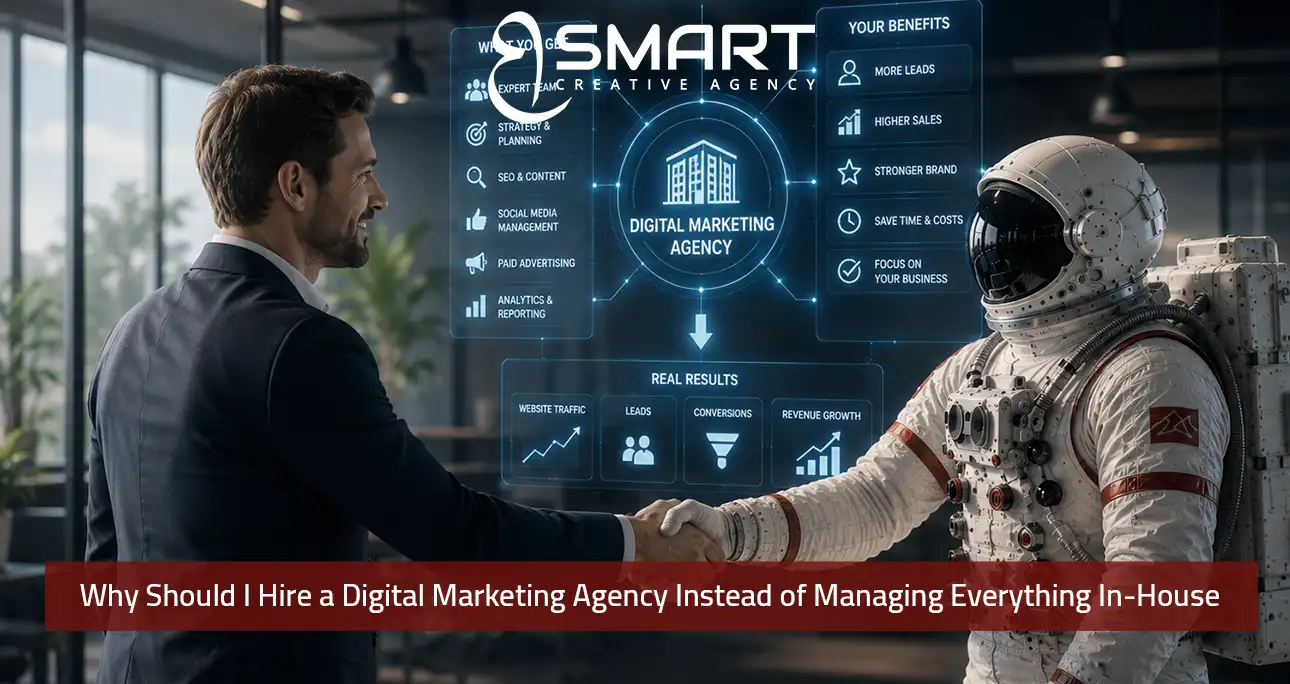
This decision genuinely depends on your business’s specific scale, budget, and internal capacity, and there are legitimate scenarios favoring each approach — but understanding the actual tradeoffs, rather than assuming one option is universally superior, allows for a decision grounded in your specific situation rather than generic advice that doesn’t account for your particular constraints.
The Advantages of Hiring a Digital Marketing Agency
Access to Specialized Expertise
The core advantage an agency provides is access to specialized expertise across multiple disciplines simultaneously, at a cost that’s typically far lower than hiring equivalent in-house specialists for each discipline. Effective digital marketing genuinely requires expertise across several distinct, deep specializations — technical SEO, paid advertising platform management, social media optimization, content strategy and creation, web development, conversion optimization, analytics and measurement — and few individuals possess deep, current expertise across all of these areas simultaneously, since each one is a substantial specialization in its own right that evolves continuously. Hiring a single in-house marketing generalist typically means getting adequate, but not deeply expert, coverage across each of these areas, while hiring a full team of in-house specialists for each discipline represents a substantial payroll commitment that’s simply not viable for most small and mid-sized businesses given typical marketing budgets. An agency provides access to a team with deep expertise across these specializations at a fraction of what assembling an equivalent in-house team would cost, because that expertise and its associated cost is shared across the agency’s full client base rather than dedicated entirely to a single business.
Pattern Recognition and Proven Strategies
Agencies also bring pattern recognition and proven strategies developed across many client engagements across different industries and situations, which represents a genuine, hard-to-replicate advantage: an in-house team, however talented, is learning primarily from their own single business’s data and experience, while an agency has directly observed what works and what doesn’t across dozens or hundreds of different businesses facing similar challenges, providing a depth of comparative pattern recognition that’s genuinely difficult for a single in-house perspective to replicate, regardless of talent or effort.
Access to Professional Marketing Tools
Access to advanced tools and platforms is a further practical advantage: professional-grade SEO research tools, advertising platform management and reporting tools, and analytics platforms often carry substantial subscription costs that are difficult to justify for a single business’s usage alone, but become cost-effective when the expense is spread across an agency’s full client roster, giving even small businesses working with an agency access to enterprise-grade tooling that would be difficult to justify purchasing independently for in-house use alone.
When an In-House Marketing Team Makes More Sense
That said, there are legitimate scenarios where building an in-house team, or a hybrid model combining in-house strategy with agency execution support, makes more sense than a fully agency-managed approach. Businesses at a sufficient scale where the marketing function represents a large enough investment to justify dedicated, deeply specialized full-time staff across each discipline may find that a well-built in-house team, deeply embedded in the business’s specific context and able to move with fewer communication overhead layers than an external agency relationship requires, delivers better results at that scale, even if the absolute cost is higher than an agency engagement would have been. Similarly, businesses in highly specialized, technical, or regulated industries where deep, ongoing product and market context is essential to effective marketing may find that the learning curve and context-building an external agency requires offsets some of the specialized expertise advantage the agency otherwise provides.
How to Decide Between an Agency and an In-House Team
The realistic decision framework weighs your current marketing budget against what it would genuinely cost to hire equivalent specialized expertise in-house across every discipline you actually need, factoring in not just salary but the substantial time cost of recruiting, managing, and retaining a multi-disciplinary in-house team, and the very real risk of key-person dependency if your in-house expertise is concentrated in one or two individuals whose departure could significantly disrupt your marketing function. For the substantial majority of small and mid-sized businesses, a well-chosen agency relationship delivers a broader range of specialized expertise, proven pattern recognition across many client situations, and access to advanced tooling, at a total cost meaningfully lower than building an equivalent in-house team — which is precisely why agency partnerships remain the dominant model for businesses below a certain scale threshold, while larger enterprises with marketing budgets substantial enough to justify full in-house specialist teams increasingly favor a hybrid or fully in-house model instead.
Compare the True Cost Before Making a Decision
A practical way to test this decision for your own business is to price out, honestly and specifically, what it would cost to hire dedicated, genuinely qualified specialists — not generalists — for every discipline your marketing actually requires: a technical SEO specialist, a paid media manager, a content strategist and writer, a web developer, and someone dedicated to analytics and reporting. Compare that fully loaded cost, including recruitment time and management overhead, against a well-vetted agency proposal covering the same scope of work. For most businesses below a certain revenue threshold, this comparison alone makes the decision self-evident, and it removes the decision from a vague preference about “control” and grounds it in an honest, comparable cost analysis.
How to Get the Best Results from an Agency Partnership
It’s also worth being clear-eyed about what makes an agency relationship succeed once the decision is made, since not every engagement delivers the benefits described above automatically. The businesses that get the most value from an agency partnership treat it as a genuine collaboration rather than a hands-off outsourcing arrangement — sharing real business context, responding promptly to requests for input or approval, and maintaining regular communication about how marketing performance connects to broader business goals. An agency relationship approached passively, with minimal internal engagement or oversight, tends to underperform regardless of how skilled the agency itself is, simply because effective marketing strategy requires ongoing business context that only the business itself can fully provide, and a disengaged client relationship starves even a highly capable agency of the information it needs to perform at its best, no matter how deep its specialized expertise or how strong its track record with other clients might otherwise be across a wide range of industries and situations.
Discover More Answers
AI-powered search visibility :Can AI Help Improve My Website’s Online Visibility?


