

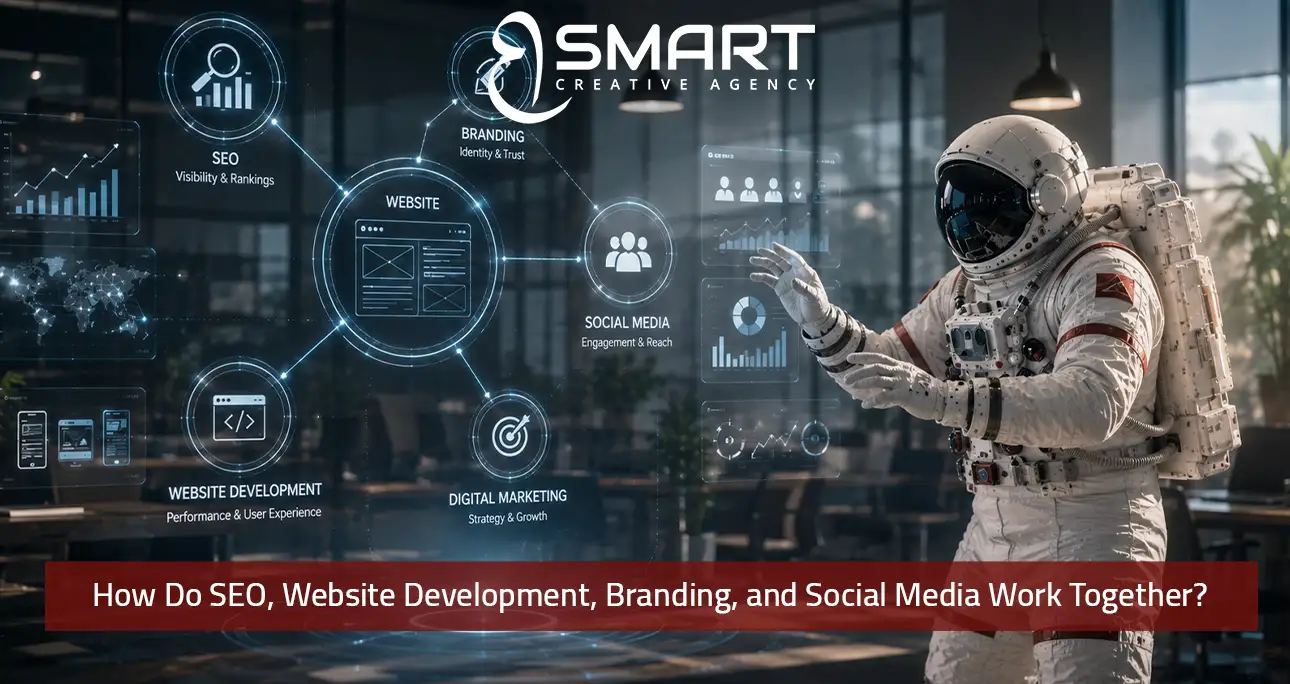
Treating these four disciplines as separate line items on a budget, each managed independently and measured in isolation, is one of the most common structural mistakes businesses make in digital marketing, because in practice these four areas function as an interconnected system where the performance of each one directly affects the ceiling of the others. Understanding the actual mechanics of how they interact changes both how you sequence investment and how you evaluate whether each one is actually working.
Website Development: The Foundation of Digital Marketing Success
Website development is the foundational layer because it is the destination every other channel ultimately points toward. SEO drives traffic to the website; social media links back to it; branding is expressed through it. If the website itself is slow, poorly structured, or unclear, it functions as a bottleneck that caps the return of every other investment regardless of how well those other channels perform individually. This is why website performance should typically be addressed before scaling investment in traffic-generating activities — driving more visitors to a website with a fundamental conversion problem multiplies wasted spend rather than multiplying results.
Why SEO and Website Development Must Work Together
SEO and website development are so tightly interconnected that treating them as separate disciplines, managed by disconnected teams, frequently produces conflict rather than synergy. Search engines evaluate not just content relevance but technical site health — load speed, mobile usability, secure connections, clean site architecture — as ranking factors in their own right. A beautifully designed website that ignores these technical SEO fundamentals will underperform in search regardless of content quality, while an SEO strategy that produces excellent content on a technically poor website will see diminished returns because the technical weaknesses suppress rankings that the content quality alone would otherwise earn.
How Branding Improves SEO and Social Media Performance
Branding shapes how effectively both SEO traffic and social media traffic convert once they arrive. Strong branding — consistent visual identity, a clear and differentiated value proposition, credible trust signals — increases the percentage of visitors from any traffic source who take the desired action, because visitors who land on a page that feels professional, trustworthy, and clearly differentiated convert at meaningfully higher rates than those landing on a generic, unbranded page, even when the underlying offer and traffic quality are identical. This means the same SEO investment, the same paid campaign, or the same social media effort will produce a measurably different return depending entirely on the strength of the branding layer it feeds into. Businesses that invest heavily in traffic generation while neglecting branding are effectively pouring water through a smaller funnel than necessary.
The Role of Social Media in the Digital Marketing Ecosystem
Social media contributes to this system in two distinct ways that are frequently conflated. Directly, it drives referral traffic and builds an audience that can be re-engaged without additional acquisition cost. Indirectly, and less obviously, active and engaged social media presence contributes to the trust signals that both human visitors and, increasingly, search engines associate with a credible, established business — a company that appears active, responsive, and engaged across multiple channels reads as more trustworthy than one with a single, static website and no other digital footprint, and this perceived credibility affects conversion rates on all other channels, not just social media itself.
What Happens When One Element Is Weak?
The interconnection becomes most visible when one element is weak: a business with excellent SEO rankings but weak branding will see traffic arrive and bounce at a higher rate than the ranking position would suggest, because visitors don’t trust or connect with what they find once they click through. A business with strong branding and social media presence but a poorly optimized website will struggle to be found by new prospects in the first place, regardless of how compelling their brand identity is, because compelling branding on a page nobody discovers produces no return. A business with strong website development and SEO but no branding differentiation will find itself competing primarily on price, because nothing distinguishes their offer from a competitor’s in the mind of a prospect comparing options.
Why an Integrated Strategy Outperforms Isolated Marketing Efforts
The practical implication is that measuring these four disciplines in isolated silos — judging SEO purely by ranking position, social media purely by follower count, branding purely by subjective design opinions — misses the actual mechanism by which they create value, which is compounding, not additive. A coordinated strategy where website performance, technical SEO, content quality, brand consistency, and social presence are planned together, and measured against shared business outcomes like conversion rate and customer acquisition cost rather than channel-specific vanity metrics, consistently outperforms the same total budget split across disconnected initiatives managed without reference to how they interact.
How to Identify the Weakest Link in Your Digital Strategy
A useful diagnostic question to ask periodically is: “which of these four is currently the weakest link, and is it suppressing the return on the other three?” If your website converts poorly despite good traffic, the weak link is likely the website or branding layer, not the traffic-generating channel bringing visitors there in the first place — and no amount of additional SEO or social media investment will fix a conversion problem sitting downstream of it. If your branding and website are strong but almost nobody finds you, the weak link is visibility, and SEO or paid channels deserve the next dollar of investment rather than further refining an already-solid brand. Treating these four areas as a connected system, and periodically identifying which one is currently the bottleneck, produces a far better return than evenly splitting a budget across all four regardless of which one is actually limiting results at any given time.
Why Businesses Should Coordinate SEO, Branding, Web Development, and Social Media
It’s also worth addressing why so many businesses still manage these four disciplines through separate vendors or separate internal teams that rarely coordinate with each other, despite this interconnection being well understood: specialization is genuinely valuable, and few individuals or even small internal teams have deep expertise across all four areas simultaneously. The practical solution is not necessarily consolidating everything under one specialist, which is rare and expensive, but ensuring whoever oversees the overall marketing function — whether an internal marketing lead or an account manager at an agency — actively coordinates across these four areas with shared goals and shared visibility into how each one is performing, rather than allowing four independently managed workstreams to operate without any awareness of how their output affects the others.
Discover More Answers
Website Redesign Vs Optimization :Do I Need a New Website, or Can My Current One Be Improved?


