

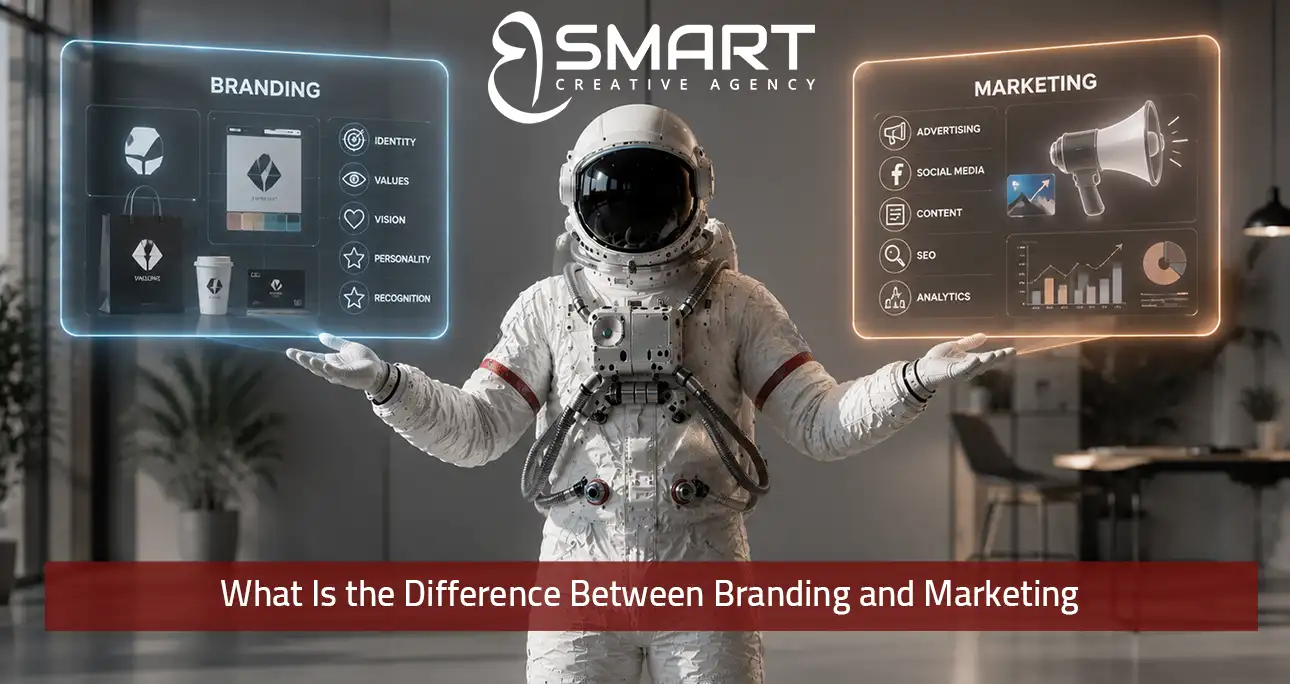
Confusing these two concepts leads to a very specific and common business mistake: investing heavily in marketing tactics (ads, campaigns, promotions) while neglecting the underlying brand foundation those tactics depend on, resulting in marketing that generates attention but fails to convert that attention into lasting customer relationships and premium positioning. Understanding the actual distinction — and more importantly, the relationship between the two — changes how you sequence and evaluate your investment in each.
What Is Branding?
Branding is fundamentally about identity and perception: it is the answer to the question “who are you, and why should someone care?” This encompasses your visual identity (logo, colors, typography, imagery style), but far more importantly, it encompasses your positioning (what specific problem you solve better than alternatives, and for whom specifically), your values and personality (how your business communicates and what it stands for beyond the transaction itself), and the consistent experience customers have across every touchpoint with your business. Branding is largely stable over time — it shouldn’t shift dramatically month to month — and it exists whether or not you’re actively running any marketing campaign at all, because it’s expressed through every interaction a customer has with your business, from your website’s tone to how your team answers the phone.
What Is Marketing?
Marketing, by contrast, is fundamentally about communication and action: it is the set of activities and campaigns designed to reach specific audiences with specific messages at specific moments, with the goal of driving a specific action — awareness of a new product, a specific promotional offer, engagement with new content. Marketing is inherently more tactical and time-bound than branding; a marketing campaign has a start date, an end date, specific metrics it’s measured against, and a specific audience it’s targeting for a specific reason, in contrast to branding’s more constant, foundational presence.
How Branding and Marketing Work Together
The critical relationship between the two is that branding determines the ceiling of marketing’s effectiveness, while marketing is the vehicle that delivers the brand to an audience and drives the specific actions a business needs. Strong branding makes every marketing dollar work harder: an ad campaign for a business with clear, differentiated positioning and a trusted, recognized identity will consistently outperform the identical campaign — same targeting, same budget, same offer — run by a business with generic, undifferentiated branding, because the audience receiving the message already has a foundation of trust and clarity about who’s speaking to them and why they should care, rather than having to build that understanding from a single ad exposure alone. This is why two businesses can run functionally identical marketing campaigns and see meaningfully different results — the campaign isn’t actually identical in effectiveness, because it’s being filtered through different underlying brand foundations that the audience perceives, consciously or not.
A Practical Example of Branding vs. Marketing
A practical way to see this distinction in action: imagine two competing businesses running the identical paid advertising campaign, same budget, same targeting, same offer. The business with strong, clear branding — differentiated positioning, professional and consistent presentation, credible trust signals — will typically see a meaningfully higher conversion rate on that identical traffic, because prospects clicking through encounter a business that feels credible and clearly different from alternatives. The business with weak or generic branding will see the same traffic convert at a lower rate, not because the marketing tactic was executed differently, but because the underlying brand foundation the marketing was pointing toward gives prospects less reason to trust and choose that specific business over alternatives they could just as easily click through to instead.
Why Branding Should Come Before Heavy Marketing Investment
This relationship has a direct practical implication for sequencing investment: businesses that pour marketing budget into campaigns before establishing clear branding and positioning are effectively paying to send traffic toward a foundation that isn’t yet strong enough to convert that traffic efficiently, producing weaker results than the same budget would generate once directed at a business with clearer positioning and stronger brand foundations. This doesn’t mean branding must be perfected before any marketing begins — the two can and should develop together — but it does mean that businesses experiencing weak marketing performance despite reasonable tactical execution should seriously examine whether the underlying branding, not the marketing tactics themselves, is the actual limiting factor, since no amount of marketing sophistication can fully compensate for a business that hasn’t clearly defined who it is and why a prospect should choose it over the alternative that’s one click away.
How to Tell if You Have a Branding Problem
A quick diagnostic for any business questioning whether a marketing underperformance problem is actually a branding problem: if you asked ten people who have visited your website or seen your ads to describe, in one sentence, what makes your business different from the closest alternative, would they give ten similar, clear answers, or ten vague, inconsistent ones? If the honest answer is the latter, no amount of additional marketing spend or tactical refinement will fully resolve the underlying issue, because the audience genuinely doesn’t yet have a clear reason to choose you specifically — and that clarity is branding’s job to establish before marketing can efficiently deliver it to a wider audience.
Branding vs. Visual Design
A related distinction worth clarifying is between branding and simple visual design, since the two are frequently conflated. A logo refresh or a new color palette is a design update, not a branding strategy, unless it’s grounded in a clear, deliberate answer to the positioning questions above — who specifically you serve, what specific problem you solve better than alternatives, and what your business genuinely stands for beyond the transaction. A business can invest in an expensive visual redesign and still have weak branding in the meaningful sense described here, if that redesign wasn’t preceded by real strategic clarity about positioning and differentiation. Conversely, a business with a modest visual identity but genuine clarity about who it serves and why can have surprisingly strong branding in the sense that actually drives marketing performance, because the strategic foundation, not the polish of the visual execution alone, is what does the heavy lifting in the relationship between branding and marketing effectiveness.
Discover More Answers
long-term brand growth : Why Is Branding Important for Long-Term Business Growth?


