

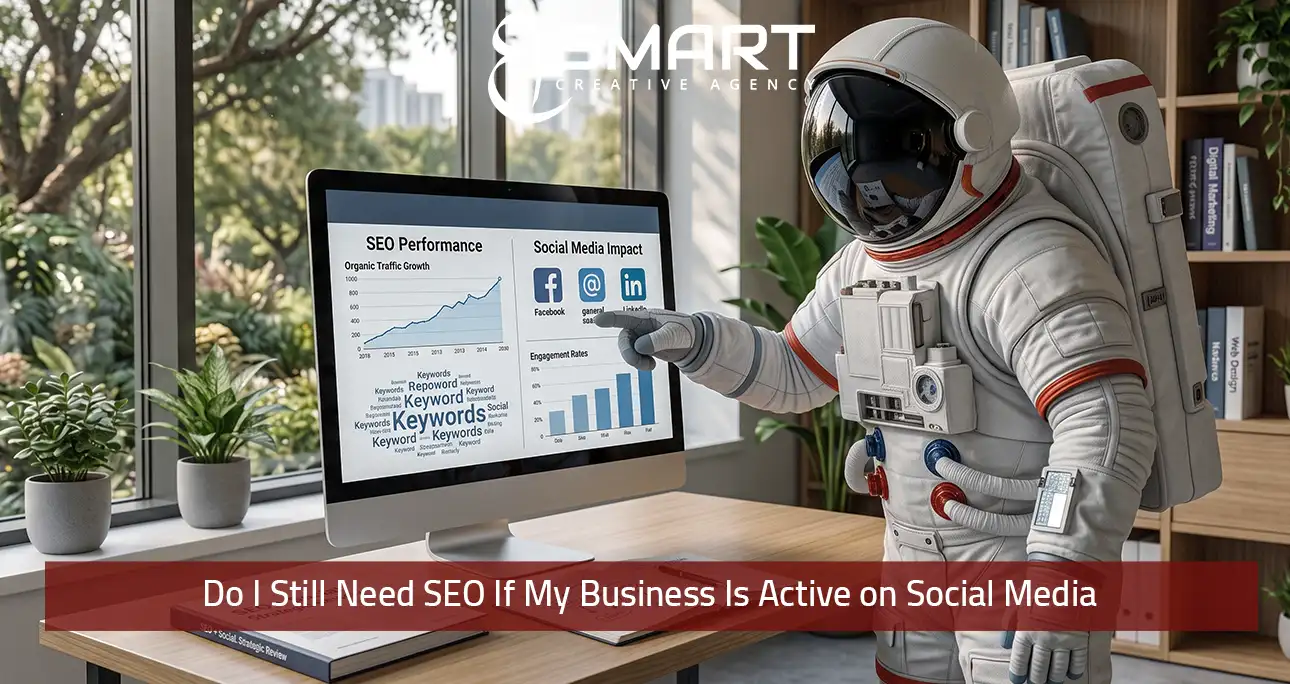
This question reflects a common and understandable assumption — that a strong social media presence covers the “visibility” need, making SEO redundant — but the assumption breaks down once you examine what each channel actually captures in terms of user intent and behavior, because social media and search serve fundamentally different moments in a customer’s decision-making process, and neither one can substitute for the other without leaving a significant gap in your visibility.
SEO vs. Social Media: Intent vs. Interruption
The core distinction is intent versus interruption. Search engine users are actively expressing a need at the exact moment they type a query — someone searching “emergency plumber near me” or “best project management software for small teams” has a specific, current problem they’re trying to solve right now, and they are actively looking for a solution. This is often described as “pull” marketing: the user is pulling information toward themselves because they already want it. Social media, by contrast, operates primarily as “push” or interruption-based discovery: content appears in a user’s feed regardless of whether they were actively looking for it at that moment, based on their general interests, past behavior, and social connections, not an active, immediate need.
Why SEO and Social Media Reach Different Audiences
This distinction matters enormously in practice because it means SEO and social media capture entirely different segments of your potential customer base, with minimal overlap. A business relying exclusively on social media will completely miss the substantial segment of prospects who have a specific need right now and are actively searching for a solution but don’t happen to follow that business’s social accounts, don’t see the relevant post in their algorithmically curated feed at the right moment, or aren’t active on the specific platform the business focuses on. These are often the highest-intent, most ready-to-convert prospects available — someone actively searching for your exact service converts at a fundamentally different rate than someone who happens to see an ad or organic post while scrolling for entertainment, because the searcher has already identified and expressed their need, while the social media viewer may not have been thinking about that need at all until the content interrupted their scrolling.
The Organic Reach Limitation of Social Media
The reach limitation of social media compounds this gap: organic reach on most major social platforms has declined substantially over the years as platforms prioritize paid promotion and algorithmic curation, meaning even businesses with a genuinely engaged following typically reach only a small fraction of their total followers with any given organic post, and reach essentially zero prospects who don’t already follow the business at all. SEO, by contrast, exposes your business to entirely new prospects who have never heard of you but are actively searching for exactly what you offer — a category of prospect that social media, by its follower-based structure, structurally cannot reach in the same way.
SEO Provides Long-Term Value
There’s also a longevity and compounding difference worth understanding. A social media post has a brief window of visibility — often measured in hours or at most a few days — before it’s buried beneath newer content in followers’ feeds and effectively stops generating any further reach or engagement. A well-optimized page targeting a specific search query, by contrast, can continue generating consistent traffic for months or years after it’s published, with essentially no additional cost or effort required to sustain that visibility, making SEO a fundamentally different kind of asset — one that accumulates and compounds rather than requiring constant new content just to maintain the same level of visibility.
Why SEO and Social Media Work Better Together
None of this means social media is less valuable — it excels at building relationships, brand awareness, and community engagement with people who may not have an immediate need but will remember and consider your business when that need eventually arises, and it provides a direct, real-time channel for customer service and engagement that search simply doesn’t offer. The two channels are complementary, addressing different stages and different moments of the customer journey, not substitutes for one another. A comprehensive digital presence needs both: SEO to capture the active, high-intent searchers who don’t yet know your business exists, and social media to build lasting relationships and repeat engagement with an audience that does. Treating either one as sufficient on its own leaves a substantial, identifiable gap in your overall visibility and customer acquisition strategy.
How to Evaluate the Role of SEO in Your Business
A useful way to test this for your own business is to ask how many of your last twenty customers found you by actively searching for something related to your product or service versus how many discovered you passively while scrolling a social feed. Most businesses, when they actually investigate this honestly rather than assuming, discover that a meaningful share of their customers came through active search — often a majority for service-based and problem-solving businesses — which is direct evidence of demand your social media presence alone, however strong, structurally cannot capture on its own, simply because it doesn’t put you in front of someone at the specific moment they’re actively looking for what you offer.
Should You Invest in SEO or Social Media?
A common objection at this point is budget: if resources are genuinely limited, which one should be cut rather than maintained alongside the other? The honest answer is that cutting SEO entirely to fund social media, or vice versa, based purely on which one feels more comfortable or familiar to manage, is rarely the right basis for that decision. A better approach is to look at where your specific business currently has the larger visibility gap — if you rank poorly for the terms your customers actually search, that gap is costing you high-intent prospects every single day it remains unaddressed, and closing it typically deserves priority over expanding an already-active social media presence further. If your search visibility is already reasonably strong but your social presence is dormant or nonexistent, the reverse may be true. The decision should follow from an honest assessment of your current gap, not a default preference for whichever channel feels more familiar or comfortable to manage — and revisiting that assessment every few months, as one gap closes and priorities shift, keeps the allocation aligned with where the business actually needs attention next rather than where it happened to start.
Discover More Answers
social media posting schedule :How Often Should My Business Post on Social Media?


